

The clash between the Denver Broncos and the Buffalo Bills is a modern NFL saga, blending the rich history of two original AFL franchises with the intense, high-stakes football of today. This rivalry has produced unpredictable outcomes, often influenced by the brutal winter conditions of Orchard Park or the thin air of Denver. From legendary quarterbacks to dominant defensive units, every encounter adds another chapter to this compelling story.
I. Recent Match Overview: The AFC Wild Card Battle (2025 Season)
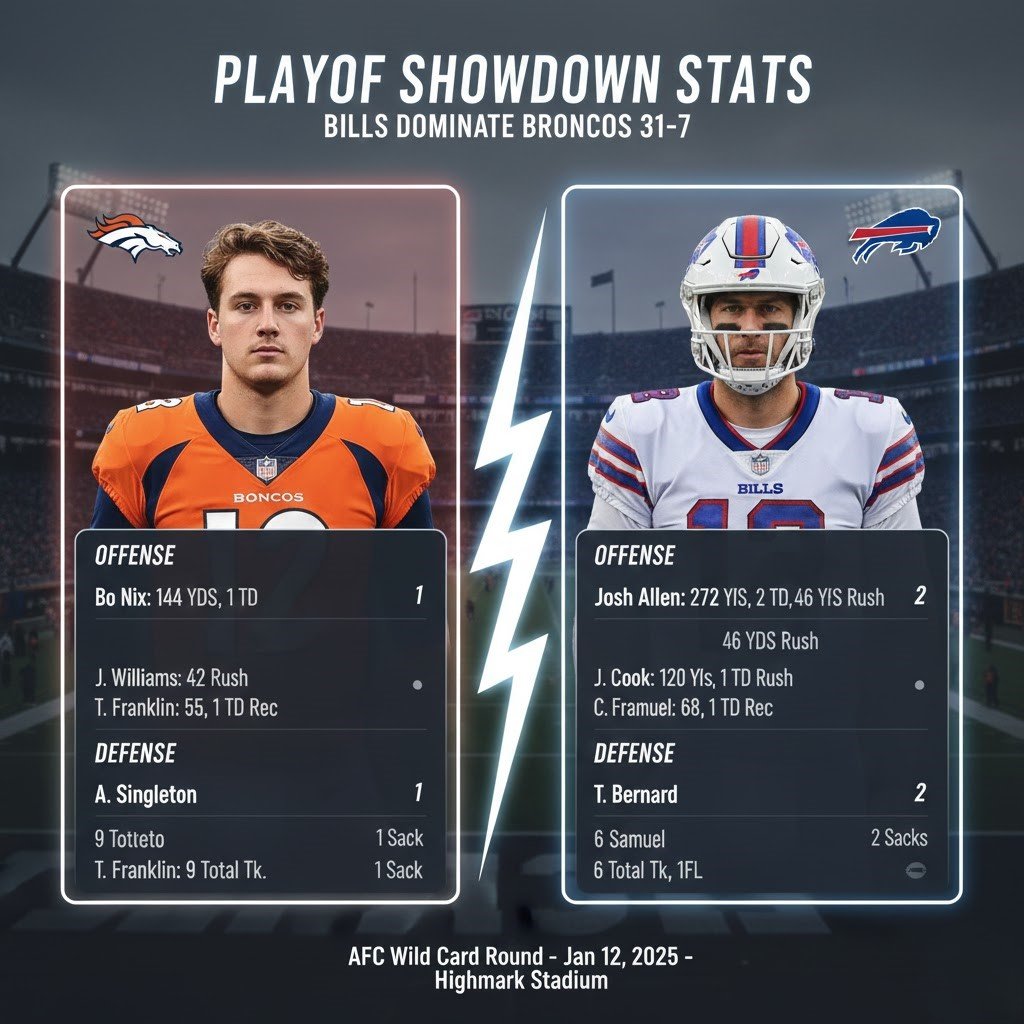
The most recent encounter, a pivotal AFC Wild Card game on January 12, 2025, served as a stark reminder of the challenges a young team faces against a seasoned playoff contender. The Buffalo Bills leveraged their home-field advantage and veteran leadership to secure a convincing victory.
Game Snapshot: 2025 AFC Wild Card Round
| Feature | Detail |
| Date | January 12, 2025 |
| Venue | Highmark Stadium, Orchard Park, NY |
| Final Score | Buffalo Bills 31, Denver Broncos 7 |
| Temperature | 34°F (Overcast) |
| Key Takeaway | Bills’ offensive line dominance and Josh Allen’s efficiency proved overwhelming for Denver’s emerging defense. |
II. Offensive Player Statistics: A Tale of Two QBs and Contrasting Styles
The statistics from this Wild Card game reveal two distinct offensive strategies. The Bills executed a balanced, high-efficiency attack, while the Broncos, led by their rookie quarterback, struggled to sustain drives against an aggressive Buffalo defense.
1. Quarterback Performance Comparison
This chart highlights the contrasting performances of the two signal-callers, with Josh Allen’s veteran poise clearly outshining rookie Bo Nix’s efforts under playoff pressure.
| Metric | Josh Allen (BUF) | Bo Nix (DEN) |
| Completions/Attempts | 20/26 (76.9%) | 13/22 (59.1%) |
| Passing Yards | 272 | 144 |
| Touchdowns | 2 | 1 |
| Interceptions | 0 | 0 |
| Passer Rating | 132.2 | 93.8 |
| Rushing Yards | 46 | 14 |
| Sacks Taken | 1 | 2 |
Analysis: Allen’s near-flawless performance, marked by zero turnovers and a high completion percentage, minimized risks and maximized offensive output. Nix, while showing flashes of potential with an early touchdown, struggled to find consistent rhythm against a relentless Bills’ pass rush.
2. Rushing Game Domination
The ground game was a significant differentiator. Buffalo’s ability to consistently gain positive yardage wore down the Broncos’ defense and controlled the clock.
Leading Rushers
| Player | Team | Carries | Rushing Yards | Touchdowns | Avg. Per Carry |
| James Cook | BUF | 23 | 120 | 1 | 5.2 |
| Ty Johnson | BUF | 9 | 70 | 1 | 7.8 |
| Javonte Williams | DEN | 11 | 42 | 0 | 3.8 |
| Samaje Perine | DEN | 3 | 17 | 0 | 5.7 |
Insight: James Cook’s consistent production, including a long run of 28 yards, prevented the Broncos’ defense from keying solely on the pass. Conversely, Denver’s inability to establish a strong run game placed immense pressure on Bo Nix.
3. Receiving Corps Impact
The Bills spread the ball effectively, preventing Denver’s star cornerbacks from completely shutting down any single receiver.
Top Receiving Performances
| Player | Team | Receptions | Receiving Yards | Touchdowns | Longest Catch | Targets |
| Curtis Samuel | BUF | 4 | 68 | 1 | 35 | 5 |
| Khalil Shakir | BUF | 6 | 61 | 0 | 18 | 7 |
| Troy Franklin | DEN | 2 | 55 | 1 | 43 | 4 |
| Courtland Sutton | DEN | 4 | 38 | 0 | 15 | 6 |
| Dalton Kincaid | BUF | 3 | 35 | 0 | 20 | 4 |
Analysis: Curtis Samuel and Khalil Shakir’s contributions were crucial for the Bills, turning short passes into significant gains. For Denver, rookie Troy Franklin’s long touchdown catch provided a brief moment of hope, demonstrating his explosive potential.
III. Defensive Metrics: The Battle in the Trenches and Secondary
Defense was a major talking point leading into this game, with both teams boasting playmakers. The Bills’ defense, however, proved superior on this day, consistently disrupting Denver’s offensive flow.
1. Defensive Pressure & Sacks
The Bills’ defensive line consistently pressured Bo Nix, leading to hurried throws and limited time in the pocket.
Quarterback Pressure Statistics
| Team | Sacks | QB Hits | Total Pressures | Pressure Rate (%) |
| Buffalo Bills | 2 | 8 | 14 | 56.0% |
| Denver Broncos | 1 | 3 | 6 | 28.6% |
Key Player Spotlight: Gregory Rousseau (BUF)
Rousseau was a force off the edge, recording 1.5 sacks and 3 QB hits, consistently collapsing the pocket and forcing Nix off his spot.
2. Tackling & Disruptions
Linebacker play was critical in containing the run and defending against short passes.
Individual Tackling Leaders
| Player | Team | Solo Tackles | Assisted Tackles | Total Tackles | Tackles For Loss (TFL) |
| Alex Singleton | DEN | 7 | 2 | 9 | 0 |
| Terrel Bernard | BUF | 5 | 1 | 6 | 1 |
| Damar Hamlin | BUF | 4 | 1 | 5 | 0 |
| Justin Simmons | DEN | 4 | 0 | 4 | 0 |
Analysis: While Alex Singleton amassed a high tackle count for Denver, many of these were made after Buffalo had already gained significant yardage. Terrel Bernard’s TFL underscored his ability to penetrate the backfield and disrupt plays.
3. Third Down Efficiency
A critical metric for defensive success, Buffalo’s ability to get off the field on third down stifled any potential Broncos’ comeback.
Third Down Conversion Rates
| Team | 3rd Down Conversions | 3rd Down Attempts | Conversion Rate (%) |
| Denver Broncos | 3 | 11 | 27.3% |
| Buffalo Bills | 8 | 13 | 61.5% |
Verdict: The Bills’ defense was dominant on third downs, forcing punts and maintaining field position advantage.
IV. Comprehensive Team Statistics: A Full Picture of Dominance
The overall team statistics paint a clear picture of Buffalo’s control over the game, highlighting their efficiency and Denver’s struggles to generate sustained offense.
Game Flow & Efficiency Metrics
| Statistic | Denver Broncos | Buffalo Bills |
| Total First Downs | 12 | 24 |
| Total Net Yards | 223 | 445 |
| Rushing Yards | 79 | 210 |
| Passing Yards | 144 | 235 |
| Time of Possession | 25:38 | 34:22 |
| Red Zone Efficiency (TD%) | 1/1 (100%) | 3/4 (75%) |
| Turnovers (Given) | 0 | 0 |
| Penalties / Yards | 6 / 55 | 3 / 25 |
Observation: The Bills’ significant advantage in “Time of Possession” (nearly 10 minutes more than Denver) was a direct result of their strong running game and efficient passing on early downs, which kept their defense fresh and Denver’s off the field.
V. Advanced Analytics: Beyond the Box Score
Delving deeper into advanced metrics reveals the underlying strategic successes and failures that shaped the game’s outcome.
1. Expected Points Added (EPA) per Play
EPA measures the change in expected points (based on down, distance, and field position) contributed by each play. A positive EPA indicates a successful play.
Offensive EPA/Play
| Team | Overall EPA/Play | Passing EPA/Play | Rushing EPA/Play |
| Buffalo Bills | +0.24 | +0.28 | +0.17 |
| Denver Broncos | -0.12 | -0.08 | -0.19 |
Interpretation: The Bills’ offense consistently generated positive value, especially through the air, while Denver’s offense was largely unproductive, with both passing and rushing plays leading to a decrease in expected points.
2. Success Rate
Success Rate measures the percentage of plays that generate a positive EPA.
Offensive Success Rate
| Team | Overall Success Rate (%) | 1st Down Success Rate (%) | 3rd Down Success Rate (%) |
| Buffalo Bills | 58.0% | 65.0% | 61.5% |
| Denver Broncos | 35.0% | 40.0% | 27.3% |
Conclusion: The Bills’ high success rate, particularly on first downs, allowed them to dictate terms and avoid unfavorable down-and-distance situations, preventing Denver’s defense from unleashing their full array of blitzes.
VI. Historical Context: A Rivalry Forged in the AFL
The Broncos vs. Bills rivalry is deeply rooted in the American Football League (AFL) era and has evolved through several distinct phases.
1. All-Time Series Record
| Category | Count |
| Total Games Played | 41 |
| Buffalo Bills Wins | 23 |
| Denver Broncos Wins | 17 |
| Ties | 1 |
2. Notable Eras & Game Highlights
- AFL Founders (1960s): Both franchises were original members of the AFL. Early games often featured high-scoring affairs, though neither team reached a championship in this era.
- The Elway vs. Kelly Era (1980s-1990s): This period marked the peak of the rivalry, highlighted by legendary quarterback duels between John Elway (DEN) and Jim Kelly (BUF). Both teams were perennial playoff contenders, leading to intensely competitive matchups.
- Example: A memorable 1991 game saw the Bills, on their way to a Super Bowl appearance, narrowly defeat the Broncos 27-24 in a hard-fought contest.
- Modern Day Surprises (2000s-Present): The rivalry has continued to deliver unexpected results.
- “Monday Night Miracle” (2023): The Broncos stunned the Bills 24-22 in Orchard Park. This game was a prime example of Denver capitalizing on Buffalo’s errors, as the Bills committed four turnovers, including a critical late-game fumble. This upset served as a major talking point leading into their 2025 playoff rematch.
- The Playoff Showdown (2025): The Bills’ dominant 31-7 Wild Card victory was seen as a measure of revenge and a statement game, demonstrating their playoff pedigree at home.
VII. Player Milestones & Records Set
Individual achievements often define the emotional resonance of a game.
1. Buffalo Bills Records
- Josh Allen: Surpassed Jim Kelly for the most postseason touchdown passes in Bills franchise history (now 15). Allen also reached 600 career postseason rushing yards, joining an elite group of only 35 players in NFL history.
- James Cook: Set a Bills’ franchise record for the most rushing yards in the first quarter of a playoff game (68 yards).
2. Denver Broncos Notables
- Bo Nix: His touchdown pass to Troy Franklin was his first career postseason touchdown pass, marking a significant milestone in his young career.
- Troy Franklin: His 43-yard touchdown reception was the longest play from scrimmage for the Broncos in the game, showcasing his big-play ability.
VIII. Final Verdict: The Current State of the Rivalry
The recent Wild Card game provided a clear snapshot of where these two franchises stand.
Buffalo Bills: This team is a well-oiled machine, built for playoff success at home. Their offensive line can neutralize formidable pass rushes, and Josh Allen’s dual-threat ability remains incredibly difficult to defend. The Bills demonstrated that they are a legitimate Super Bowl contender when playing disciplined, mistake-free football.
Denver Broncos: While the score was lopsided, the Broncos showed flashes of a bright future. Bo Nix gained invaluable playoff experience against an elite defense. The defense, despite being worn down, continued to fight. Their challenge moving forward will be to build offensive consistency around Nix and develop a more potent running game to alleviate pressure on their young quarterback.
The Rivalry Continues: As the Broncos continue their rebuild, and the Bills aim for a Super Bowl, future matchups between these two teams will undoubtedly carry significant weight. The unpredictability of these contests, often impacted by weather, turnovers, and individual brilliance, ensures that Broncos vs. Bills remains a must-watch event on the NFL calendar.



Leave a Reply